Many of my clients contact me toward the end of the year wanting to take advantage of the end of the year rebates that manufacturers place on their vehicles. Rebates serve a great purpose for the automobile industry and they typically come when the new line of vehicles are coming out for the following year. A rebate really has to do with the fact that a vehicle has depreciated over the course of the year, so the manufacturer is trying to sell their remaining vehicles to get ready for the next model year. You are really just getting a discount on the vehicle because of the depreciation that has taken place throughout the year.
However, rebates can be a great way to roll negative equity in a trade. For example, if there is a $2,000 rebate on a vehicle and someone has $2,000 in negative equity, it could mean the difference between qualifying for a loan and not qualifying. Many times rebates are also placed on vehicles that are available for lease and they will call it “lease cash” or some other type of incentive. This additional money from the manufacturer can again be a fantastic way for someone to solve a nightmare that someone may find themselves in with their current vehicle.
I had a client who had this problem recently with their Mercedes Benz that needed a $5,000 repair. Rather than paying for the repair on the vehicle, they traded out of it and took the hit on the trade value of their vehicle, so they had about $5,000 in negative equity. They were able to lease a new Toyota Highlander because of the incentives that were on the vehicle and their payment on the new car only went up slightly from what they were paying for their older, broken Mercedes Benz. In three years they will be able to start over, while driving a new Toyota that included two years of free maintenance, with a lease that was structured to fit the number of miles that they drove each year.
This is a great example that many people often overlook when they are in a difficult situation with their vehicle related to repairs. Why fix an old vehicle that you still owe money on when you could start over with a lease and drive a new vehicle under warranty that can even include free maintenance? Too many people are “anti-lease” when they really don’t realize the benefits that leasing can often offer. It all depends on the structure of the lease, the situation of the person and the incentives that are included in the overall package. I recently did a lease like this for someone who was only paying about $450 in interest over three years on a $45,000 vehicle, where if they were to finance it they would have been paying more more than that in interest each year for five years. Many manufacturers will also offer 0%, 1.9% or 2.9% financing options as well, so it’s important to look at all the offers available.
Rebates and incentives can be a fantastic tool that many people can take advantage of as we head toward the end of the year. Many manufacturers like Honda and Subaru clear out of their 2013’s fast, but other manufacturers still have inventory that they have incentives on that you can leverage before year end.
John is an auto consultant with his license at a car dealership in Denver, Colorado. He can help you save time and money on any make or model, new or used, lease or purchase – nationwide! Call or email John about your next vehicle! jboyd@coolcarguy.comor Twitter @coolcarguy
The Chevrolet Volt is sold as an amazing “electric car”, but it’s really just a hybrid vehicle like a Toyota Prius that has been around for years. Now before the die hard Volt fans start screaming that the Volt is totally different, let’s just look at the reality of how these two vehicles work. The Volt and the Prius both allow you to plug them in before going for a drive and then you travel a certain distance on electricity before the batteries are exhausted. Once you’ve run out of juice, the gasoline engine will kick in and you carry on like a familiar hybrid vehicle.
What’s the big difference between the Chevy Volt and the Toyota Prius then? For one thing, the Chevy Volt uses a different battery pack than the Toyota Prius. A standard non-plugin Prius has a 1.6 kW-hr, nickel-metal-hydride battery. The Volt’s battery is a whopping 10 times larger. It’s a liquid-cooled, 16.0-kW-hr lithium-ion (chemistry by Argonne National Lab and fabrication by LG Chem). This allows it to go up to 40 miles before the engine kicks in, which is pretty fantastic on a single charge before burning gasoline. This allows many people to drive to work and back on virtually zero gasoline, which is the big rage about the Chevy Volt.
The plugin Prius version uses a different battery that is manufactured by Panasonic for Toyota. It is 73 percent smaller than the battery used in the Chevy Volt and it’s only a 4.4-kW-hr, actively air-cooled lithium-ion battery. What’s the big deal between the two? How about the price tag? I would say that is something pretty important to look at, wouldn’t you? If you need to replace a battery pack in a Chevy Volt down the road, you’re maybe looking at about $6,000 and they spent another $4,000 on the battery pack structure and those are the costs that GM paid. This is according to Bob Lutz, when he wrote about the vehicle in Forbes in September of 2012, after GM was accused of losing more than $40,000 per vehicle. He stated that the raw battery is about $350 per kW-hr, which is more like $600 in reality when you start adding all the other costs associated with making the battery work, but who’s counting. His article was funny though because he tried to claim that the cost of the vehicle was about the same as a Chevy Cruze, which it looks like a Chevy Cruze, but there isn’t a $10,000 battery pack in a Chevy Cruze. It’s kind of like the difference between a duck and a goose. “They both have wings, funny looking feet and seem to handle the cold water pretty good.”
It was reported that GM had spent an estimated $89,000 per vehicle to produce the Volt and I’m not sure if anyone really knows what the real costs were in the Land of Oz. The bottom line is that a ton of research and development, along with other manufacturing costs went into producing this vehicle. What I do know is that if you ever need to replace the battery in the Prius, it’s about $2,500. When I called a GM Dealer and asked what it costs to replace a battery in a Chevy Volt, I was told by the Service Department, “We have no idea, we haven’t had to replace one of those yet.” I should have asked if he knew the difference between a duck and a goose. I guess you could take that as good news and bad news. It is good news that the battery is working, but bad news that you are driving blind. If you ever do have to replace one that isn’t covered under their warranty – it could be very expensive. I know that some of you are saying that it’s covered under the warranty, but you obviously have never gone into a dealership and had them tell you that “Oh yeah, that’s excluded for this reason.”, which I encounter several times a year. Forgive me if I have a slight distrust of automobile manufacturers and their warranty claims.
Which brings me to the question of whether or not the Chevy Volt is a vehicle that you should be looking to own? I do mean own and not lease.
If the Munchkins in The Wizard of Oz were to sing us a song about General Motors (The Wizard) and their Chevy Volt, it might sound something like this – “If ever there was a lease there was, a lease there was, because, because, because, because…because of the unknown things it does…” Yes, the Great and Powerful Oz has spoken that this is a vehicle you should be leasing and not looking to purchase anytime soon.
In my opinion, you do not want to own a Chevy Volt. Even if the State of Colorado is going to give you a tax credit to own one, unless you have money to burn, don’t do it. If you do have money to burn and you really want to own one, please call me and I’ll be happy to sell you one for over retail, so that you can feel really good about owning one. And I will feel really good about taking your money. Seriously, you should never dream of buying this vehicle or it could turn into a nightmare down the road. However, you should seriously consider leasing a Chevy Volt. Right now you can lease a Chevy Volt for under $300 a month, which is totally crazy to drive a vehicle that costs an unknown large sum of money to produce. There are people right now driving this vehicle for around $5,050 for two years that cost GM an unknown sum of money to manufacturer.
The problem though is that GM is an unpredictable company, a bit like The Wizard of Oz. Which is why Bob Lutz can some out and say that they didn’t really lose $40,000 per vehicle because he doesn’t really know anymore than I do. This is a company that needed $60 billion in Government assistance to keep going, so who knows if they will keep this vehicle and continue to service it long term. After all, the Feds ordered them to kill Pontiac in order to get the money they needed and guess who got screwed on that deal? The customers who purchased a Pontiac and watched their brand die, along with the equity they had in their vehicles.
I recently had a friend who owns a Saturn and needed a part for her vehicle and she has had it in the shop going on two weeks waiting for GM to find the part for her car that they discontinued. GM has disposed of Pontiac, Hummer, Oldsmobile, Saturn and these were complete lines of vehicles, that actually had profitable products with a large following of customers. Why in the world would they continue to produce a vehicle that they are losing money on, each time they make a sale? I could be wrong, but I don’t think they will keep this product long term unless sales really take off, so if you are thinking about the Chevy Volt, make sure you lease one.
Toyota on the other hand has been committed to and producing the Prius for years with a great track record for customer service and knowing that people are loyal to their brand. They understand their hybrid customers much better than General Motors. I wouldn’t think twice about recommending that my clients purchase a Toyota Prius and I have many clients who own the Toyota Prius and they have had great success with them. I don’t dislike GM, but I don’t trust them when it comes to this particular vehicle. If I were writing about the GMC Yukon, the Chevy Tahoe, Suburban, Corvette or Camaro that’s a completely different story, but the Chevy Volt is an oddball car for this car company. It’s buyer beware, but it’s a fantastic vehicle to lease.
There are other hybrid vehicles on the market and they are becoming more popular, with quite a few more options that will be available in 2014. This technology will continue to get better, but be sure and look before you leap, know the company that you keep, as with any vehicle purchase.
John is an auto consultant with his license at a car dealership in Denver, Colorado. He can help you save time and money on any make or model, new or used, lease or purchase – nationwide! Call or email John about your next vehicle! jboyd@coolcarguy.comor Twitter @coolcarguy
There are a number of great reviews and videos on the Tesla Roadster on Youtube, but I thought I would post this one on The Cool Car Guy Network for our visitors and Members to check out. The Tesla Roadster was the first really cool electric car on the market. It was only manufactured from 2008 to 2012 and then Tesla switched to a Sedan, the S Model.
The car is based on the Lotus Elise body style and I have to say that I was disappointed that they discontinued this vehicle because it’s a super cool ride, as you’ll see by watching the video. According to the U.S. EPA, the cool little Roadster could travel up to 244 miles or 393 km on a single charge of its lithium-ion battery pack and then you charge it up like your cell phone each night in your garage. This fast sports car can accelerate from 0 to 60 mph (0 to 97 km/h) in 3.7 or 3.9 seconds depending on the model.
I always get a kick out of this with electric cars, but the the Roadster’s efficiency, as of September 2008, was reported as 120 mpg, which really made no sense because it runs on electricity. The Roadster was the first production automobile to use lithium-ion battery cells, which was pretty cool. It was also the first production BEV (all-electric) to travel more than 200 miles (320 km) per charge, which was revolutionary and Tesla sold out of these vehicles every year.
One other things that was really cool about this car was the way that it was sold. Tesla has stores like Apple in high-end shopping malls, like Park Meadows Mall in Lone Tree, Colorado for example. It’s right across from the Apple store, so they catch the techies as they leave one tech store to go see another tech product, which just happens to be an electric car. The Roadster had a 2010 base price of US $109,000 in the United States. However, financing was only done through Bank of America at the time and I’m honestly not sure who will finance a used one right now, but I’ll have to check into that and update this post or comment on it.
I have seen a few of these running through the Dealer Auctions and they still command a pretty penny. The 2010 in this photo only has around 3,100 miles and it’s listed for about $75,000 through the dealer auction. It’s a sweet ride though for the money. Enjoy the video.
John is an auto consultant with his license at a car dealership in Denver, Colorado. He can help you save time and money on any make or model, new or used, lease or purchase – nationwide! Call or email John about your next vehicle! jboyd@coolcarguy.comor Twitter @coolcarguy
I have people ask me all the time to get them Kelley Blue Book for their trade-in vehicle. Some people get confused when I cannot get the NADA or Kelley Blue Book wholesale trade value for their vehicle. I believe it’s because they have a misunderstanding of what Kelley Blue Book and NADA book values really are designed for. Understanding the history of the Kelley Blue Book will help to see how this tool came into being and what it has become over the years. I decided that I would write a quick post about this topic to educate my visitors about the subject.
In the early 1920s, there was an auto dealer named Les Kelley who sold a ton of vehicles through his very successful car dealership. He created a list of cars that he wanted to buy from dealers and banks and he promised to pay a stated amount to any dealer or bank that would bring him one of the vehicles on his Kelley list. Dealers would get people who would come into their office wanting to trade their vehicle and because Les was so good at estimating what a car was worth, the salesman would pull out Kelley’s list, see if the car was on it and then use it to make an offer on their vehicle. His list eventually evolved into what became the Kelly Blue Book, which is an actual book, but more people go to KBB.com today.
However, Kelly Blue Book today doesn’t buy cars for what they say they’re worth anymore, like Les would do. He wanted the vehicles for his used car inventory, so that he could turn a profit on selling them. What they are actually doing today is just giving an “opinion” and they make it clear on their site that actual prices depend on market conditions, vehicle conditions and all kinds of other disclaimers that they have in their fine print. This is because every vehicle is different and no two used cars are the same.
Think about it logically for a minute and take the emotion out of the equation. You and your neighbor could own the same exact 2008 Jeep Grand Cherokee, but your neighbor may be letting her teenager son drive her Jeep. The 17 year old is bouncing it off curbs periodically, taking it off-road with his buddies and your neighbor hardly ever changes the oil. In the meantime, you baby your Jeep, it looks like the day it left the showroom floor and has 5,000 fewer miles, regular maintenance, every time a light bulb gets dim you change it. Are these two vehicles both really worth the same? According to Kelly Blue Book they are because they are the same year, make and model.
Many of the pricing guides, like The Black Book, Kelly Blue Book and NADA also pull auction data now as well. I’ve stood in the lane at the Dealer Auctions right next to someone working for these “sources”, who will write down what vehicles are selling for at the auction. They don’t take into consideration though that one vehicle may be a condition of 2.0 out of 5.0 and another may have a condition of 4.0 out of 5.0, so they are not exactly the same vehicle. A vehicle may not have a clean CARFAX and might have been in an accident that isn’t disclosed in the dealer lane either. They have to average all the vehicles to arrive at what they believe that one is worth for their book values.
When it’s time for you to sell your vehicle, you go into your local Dealership and the Used Car Manager looks up what your vehicle has been selling for at the dealer auctions. He gives you a price for your vehicle based on the average of recent sales without considering the condition of your vehicle because he may have to sell it at the Dealer Auction himself in 30 to 60 days, if it doesn’t sell on his lot. He is also going to subtract for if the tires are worn, the windshield needs to be replaced or there are other problems with the vehicle that need to be repaired, should he want to try to retail your vehicle.
This is the reality of the automotive business, which is why Kelly Blue Book and NADA are vehicle guidelines. The real purpose of these resources are so that banks and credit unions can loan money on a particular vehicle. The banks need some way to know that the money they are loaning on a vehicle has collateral that can be taken back and sold to recover their investment, should the borrower default on the loan. This is the real value of knowing the “book value” of a vehicle.
John is an auto consultant with his license at a car dealership in Denver, Colorado. He can help you save time and money on any make or model, new or used, lease or purchase – nationwide! Call or email John about your next vehicle! jboyd@coolcarguy.comor Twitter @coolcarguy
A few years ago I wrote an article about the problems with CARFAX and how it’s not a fool proof system for checking out a vehicle. The problem of course is that most people think that it’s Gospel and fail to thoroughly investigate a vehicle from multiple sources before purchasing or selling their vehicles. Since I first wrote that article, I have been contacted by television station reporters, who have interviewed me as an expert and individuals telling me their horror stories and challenges, asking for advice. I can’t post all of the emails that I have received over the years, but here are just a couple examples that will give you an idea of what it’s like to be a “seller” instead of a “buyer” with a third-party website service devaluing your vehicle.
In other words, CARFAX and other online car history reporting services can be great tool for buyers, but it can be a nightmare for sellers when the information provided is not correct. The two emails I’m showing here are mild compared to some of the stories I have received where people have lost thousands of dollars trying to sell their vehicles that reported wrong information or information after they have purchased their vehicles.
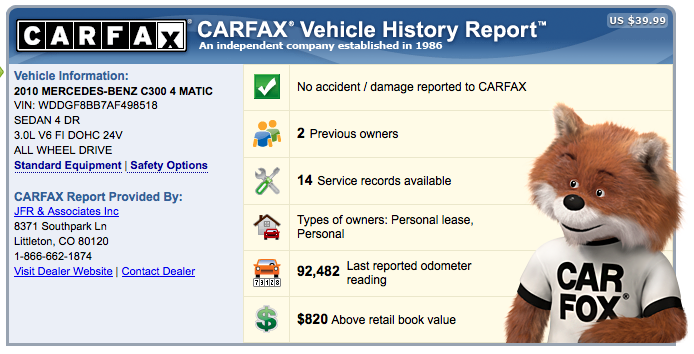
My own vehicle is a great case in point on how CARFAX can miss the boat and give people the wrong impression about a vehicle and its history. I purchased a 2010 Mercedes C300 4Matic off the show room floor. When I recently pulled the CARFAX to sell it, the vehicles history show that there were two owners. This is because I originally leased it, but I bought out the lease. There were not actually two owners of the vehicle, but really just one owner. The CARFAX doesn’t know this though because it just sees that a lease was bought out. It doesn’t tell the whole story, but only part of the story, so someone buying it would think that two people owned the vehicle based on the CARFAX report instead of one person. You can see the report below.
The Dealer Didn’t Know About The Carfax Report At The Time Of Sale…
“Hey John,
I read your piece on incorrect Carfax reports. I am dealing with them on an issue right now similar to what you described in the article- they are reporting “structural and frame damage.” The report has this accident happening 13 days before I bought the car- clearly I wouldn’t have bought it if that were the case, and the Carfax was clean at this time. I’ve owned it for over three years now and haven’t had a problem at all. I took it to a local auto rebuild shop and they inspected every part of it and said there is absolutely no structural or frame damage whatsoever.
I emailed their data team and have talked with a few of their reps- they said there next step is to discuss the matter with whatever entity reported the structural issue in the first place. I feel like because it was so long ago I’m going to get almost certainly screwed. Have you had luck with getting something like this removed before?
Any words or advice you can offer would be great.
Best,
E”
I Don’t Need The Vehicle Anymore And Carfax Is Now Bad…
“Hey John,
I have a problem with my infinity G 35. It is a 2008 at 62,000 miles on it.
My company is putting me in a fleet vehicle and I need to sell this car is I will have no use for it. When I took it to the Infiniti dealership to see if there was any price they could offer I was informed the Carfax was not clean, that is it been in an accident. They indicated that they were surprised at this and pulled another auto report auto check, another version of Carfax which showed it clean.
They then took the car into the service area put it up on the blocks to show me that the screws all around the frame had not been changed and that the original frame had not been touched. I believe what they are saying about it never having been in a wreck that altered the frame. They indicated they were going to try to contact the Carfax people and changed Carfax but did not offer anything on the car.
I realize it going to an auto dealership is not the place to sell your car back, but I was shocked to learn about the Carfax situation. Do you have any advice for me on how to best sell a car that is in good shape 62,000 miles, and great working condition? Again I love the car, I just have no more use for it as a result of my companies changing the policy.
Thanks,
B”
WHAT SHOULD YOU DO?
These situations are actually quite common. Since I wrote the first article, CARFAX now has a “minor damage” report as well. They used to just say “accident”, but many people still read “minor damage” and immediately think the vehicle is a lemon. In other words, someone could have been bumped in a parking lot, had their bumper repainted and many people think the car is not worth what it should be anymore, which is ridiculous.
The fact is that Carfax is a third-party service and pulls information on vehicles, but it’s not 100% accurate. It’s a tool to check out a vehicle and I always recommend that you check CARFAX and AutoCheck to compare the vehicle reports and have the vehicle inspected by a mechanic. The second person’s situation shows that the vehicle is fine and the data happens to be incorrect at CARFAX. I’m not saying CARFAX isn’t a good tool, but it’s not a fool proof service. In fact, on their website they have the following disclaimer…
Indemnification. You agree to defend, indemnify, and hold harmless CARFAX and its affiliates and their respective directors, officers, employees, and agents from and against any and all claims, actions, demands, damages, costs, liabilities, losses, and expenses (including reasonable attorneys’ fees) arising out of your use of the Site or any information you obtain from the Site or its reports.
Much like Kelly Blue Book and other resources that have disclaimers for their services, CARFAX is just a tool to assist you in checking out a vehicle, but it can create a huge problem when people see information that they believe to be true. It can greatly affect the price of a vehicle, when it’s accurate or when it’s not accurate and as you can see from the emails that I have received it can be very frustrating for the owner of a vehicle when the data is not accurate.
TRUST BUT VERIFY
In the end, you need to trust, but verify the data when purchasing a used vehicle. Sometimes you’re much better off just buying or leasing a new vehicle and keeping it for four or five years and letting someone else worry about buying used cars.
John is an auto consultant with his license at a car dealership in Denver, Colorado. He can help you save time and money on any make or model, new or used, lease or purchase – nationwide! Call or email John about your next vehicle! jboyd@coolcarguy.comor Twitter @coolcarguy

 Hey Cool Car Fans,
 This is a great example that many people often overlook when they are in a difficult situation with their vehicle related to repairs. Why fix an old vehicle that you still owe money on when you could start over with a lease and drive a new vehicle under warranty that can even include free maintenance? Too many people are “anti-lease” when they really don’t realize the benefits that leasing can often offer. It all depends on the structure of the lease, the situation of the person and the incentives that are included in the overall package. I recently did a lease like this for someone who was only paying about $450 in interest over three years on a $45,000 vehicle, where if they were to finance it they would have been paying more more than that in interest each year for five years. Many manufacturers will also offer 0%, 1.9% or 2.9% financing options as well, so it’s important to look at all the offers available.


 have seen a few of these running through the Dealer Auctions and they still command a pretty penny. The 2010 in this photo only has around 3,100 miles and it’s listed for about $75,000 through the dealer auction. It’s a sweet ride though for the money. Enjoy the video.